Learning Objectives
- Explain why specialized accelerators can outperform general processors for targeted workloads.
- Understand MAC arrays and data reuse.
- Introduce systolic and dataflow concepts.
- Explore accelerator array size versus utilization.
- Recognize the trade-off between specialization and flexibility.
Theory & Fundamentals
MAC arrays. Large arrays of multiply–accumulate units execute the core arithmetic of matrix and convolution operations.
Data reuse. Efficient accelerators reuse weights and activations locally to reduce costly memory traffic.
Systolic/dataflow processing. Data can flow rhythmically through arrays so many operations occur while minimizing repeated memory access.
Specialization. A more specialized design can improve efficiency but may support fewer model operators or be harder to adapt to new algorithms.
Unique Visualization
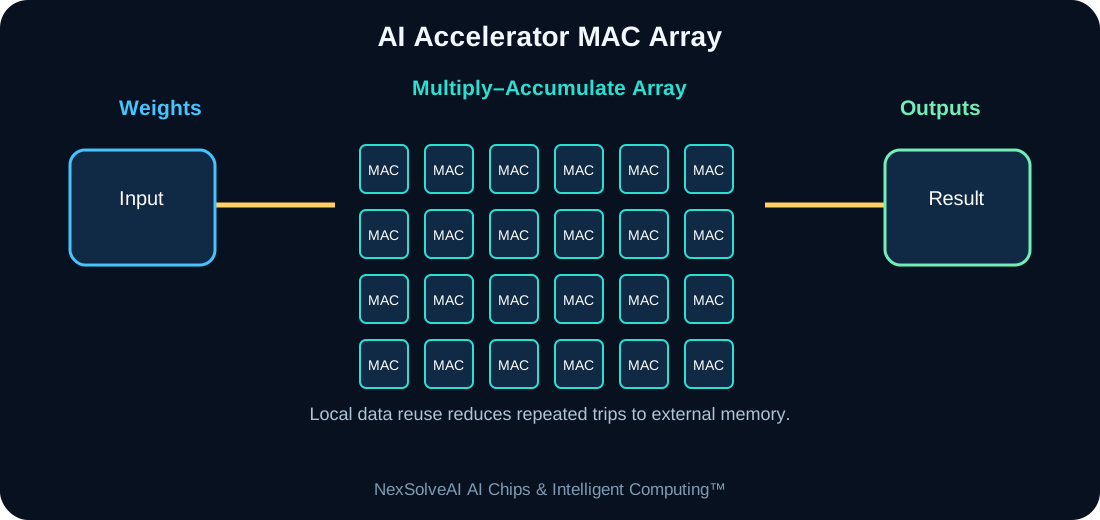
This figure is specific to AC-14 and illustrates the core architecture or dataflow discussed in this lesson.
Interactive Experiment
Array utilization—
Relative throughput—
Memory traffic—
Efficiency score—
Make the MAC array larger than the workload and observe utilization.
Real-World Case Study
A CNN accelerator may dedicate silicon area to convolution and matrix operations, achieving high efficiency for vision models but requiring fallback to CPU/GPU for unsupported operators.
Case-study task: Identify the most important compute, memory, power, and data-flow requirements in this example.
Engineering Challenge
Increase MAC array size while keeping workload size small. Explain why utilization falls when the array becomes much larger than the work available.
Common Misconceptions
- Headline specifications should not be interpreted without workload context.
- Compute, memory, data movement, software, and power interact as one system.
- More hardware resources can show diminishing returns when another subsystem is limiting performance.
Interactive MCQ Quiz
1. What does MAC stand for?
2. Why reuse data locally?
3. What is a cost of specialization?
Select your answers and submit the quiz.
Nexa AI Chip Tutor™
The future connected tutor can explain AI Accelerators, interpret this module's experiment, and answer learner questions based on the current settings.
Suggested prompt: “Explain the experiment in AC-14 and tell me why the bottleneck changes when I move the sliders.”
Downloads
References & Further Study
- Computer architecture and digital systems textbooks
- Semiconductor and processor manufacturer educational documentation
- AI hardware, edge-computing, and embedded-systems documentation