Learning Objectives
- Relate electrical power to heat generation.
- Explain thermal resistance and temperature rise qualitatively.
- Understand thermal throttling.
- Explore performance-per-watt.
- Compare passive and active cooling strategies.
Theory & Fundamentals
Power becomes heat. Most electrical energy consumed by digital computation eventually appears as heat that must be removed.
Thermal path. Heat flows from the die through package, interface materials, heat spreader, heatsink, air, or liquid cooling.
Throttling. When temperature approaches a safe limit, hardware may reduce frequency or voltage to protect itself.
Efficiency. A design delivering slightly lower peak performance at much lower power can be superior for battery-powered or fanless systems.
Unique Visualization
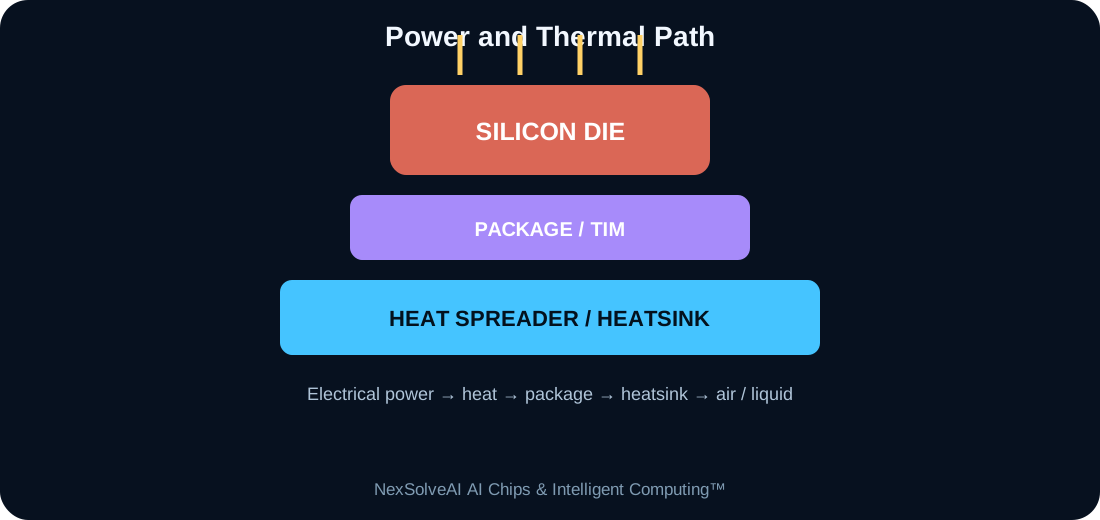
This figure is specific to AC-13 and illustrates the core architecture or dataflow discussed in this lesson.
Interactive Experiment
Estimated die temp—
Thermal margin—
Cooling class—
Throttle risk—
Use a simple temperature-rise model Tdie ≈ Tambient + P × θ.
Real-World Case Study
A compact edge AI camera may use a 10–20 W SoC and passive heatsink, while a data-center GPU can consume hundreds of watts and require powerful airflow or liquid cooling.
Case-study task: Identify the most important compute, memory, power, and data-flow requirements in this example.
Engineering Challenge
Increase simulated chip power while holding thermal resistance constant. Determine when the estimated die temperature becomes unacceptable.
Common Misconceptions
- Headline specifications should not be interpreted without workload context.
- Compute, memory, data movement, software, and power interact as one system.
- More hardware resources can show diminishing returns when another subsystem is limiting performance.
Interactive MCQ Quiz
1. Where does most chip power ultimately go?
2. What is thermal throttling?
3. Why is performance-per-watt important?
Select your answers and submit the quiz.
Nexa AI Chip Tutor™
The future connected tutor can explain Power, Heat & Cooling, interpret this module's experiment, and answer learner questions based on the current settings.
Suggested prompt: “Explain the experiment in AC-13 and tell me why the bottleneck changes when I move the sliders.”
Downloads
References & Further Study
- Computer architecture and digital systems textbooks
- Semiconductor and processor manufacturer educational documentation
- AI hardware, edge-computing, and embedded-systems documentation