Learning Objectives
- Identify common sensor types and their data characteristics.
- Explain sampling rate, resolution, and data rate.
- Recognize preprocessing roles for ADC, DSP, and ISP blocks.
- Estimate how sensor data rate affects memory and compute requirements.
- Build an end-to-end sensing-to-decision pipeline.
Theory & Fundamentals
Sensors. Sensors convert physical quantities such as light, sound, temperature, pressure, acceleration, or biological signals into electrical or digital data.
Sampling. Higher resolution and higher sampling rate provide more information but increase data rate and processing requirements.
Preprocessing. Raw sensor data may need filtering, normalization, compression, demosaicing, calibration, or feature extraction before AI inference.
Real-time pipelines. In robotics and control, processing must often complete before the next data sample arrives.
Unique Visualization
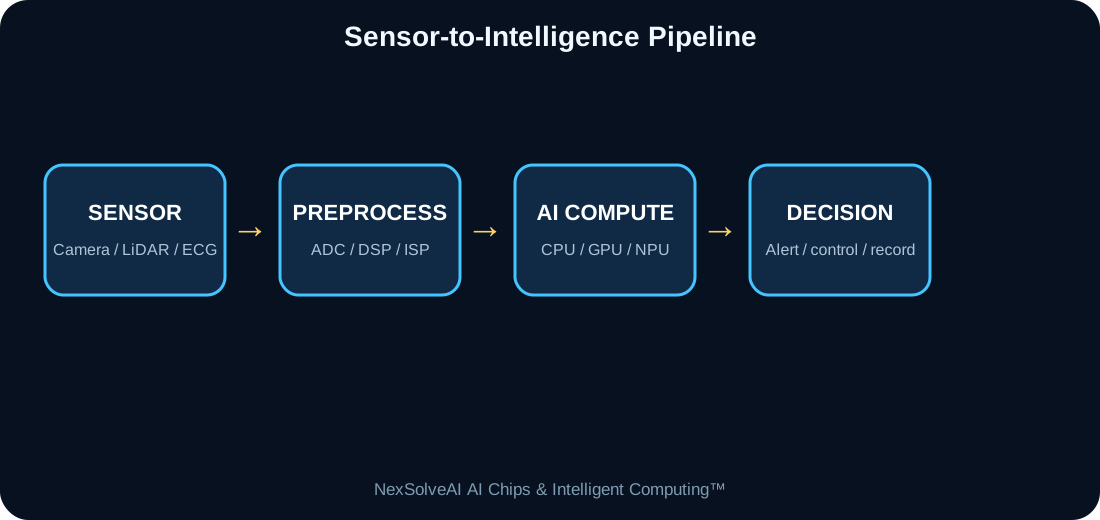
This figure is specific to AC-09 and illustrates the core architecture or dataflow discussed in this lesson.
Interactive Experiment
Raw data rate—
Memory pressure—
Compute demand—
Pipeline class—
Increase camera resolution or frame rate to see how quickly data grows.
Real-World Case Study
An autonomous mobile robot may combine camera, IMU, wheel encoders, and LiDAR. Each sensor produces different data rates and requires different preprocessing before fusion and AI inference.
Case-study task: Identify the most important compute, memory, power, and data-flow requirements in this example.
Engineering Challenge
Estimate which produces more data: a temperature sensor sampled 10 times/s or a 1080p camera at 30 frames/s. Discuss the hardware consequences.
Common Misconceptions
- Headline specifications should not be interpreted without workload context.
- Compute, memory, data movement, software, and power interact as one system.
- More hardware resources can show diminishing returns when another subsystem is limiting performance.
Interactive MCQ Quiz
1. What happens when sensor resolution increases?
2. What block often preprocesses camera data?
3. Why does sampling rate matter?
Select your answers and submit the quiz.
Nexa AI Chip Tutor™
The future connected tutor can explain Sensors + Intelligent Computing, interpret this module's experiment, and answer learner questions based on the current settings.
Suggested prompt: “Explain the experiment in AC-09 and tell me why the bottleneck changes when I move the sliders.”
Downloads
References & Further Study
- Computer architecture and digital systems textbooks
- Semiconductor and processor manufacturer educational documentation
- AI hardware, edge-computing, and embedded-systems documentation