Learning Objectives
- Define SoC and identify its major subsystems.
- Explain why integration reduces board complexity and communication distance.
- Understand the role of network-on-chip/interconnect fabric.
- Explore resource allocation inside a virtual SoC.
- Relate SoCs to phones, cars, robots, and edge devices.
Theory & Fundamentals
Integration. An SoC places many computer functions on one chip or tightly integrated package.
Interconnect. A shared bus or network-on-chip moves data among CPU, GPU, NPU, memory, and peripherals.
I/O and connectivity. SoCs may contain USB, camera interfaces, display engines, Ethernet, wireless, sensor interfaces, and security blocks.
Design trade-off. Every additional block consumes area, power, validation effort, and memory bandwidth. SoC design therefore requires system-level optimization.
Unique Visualization
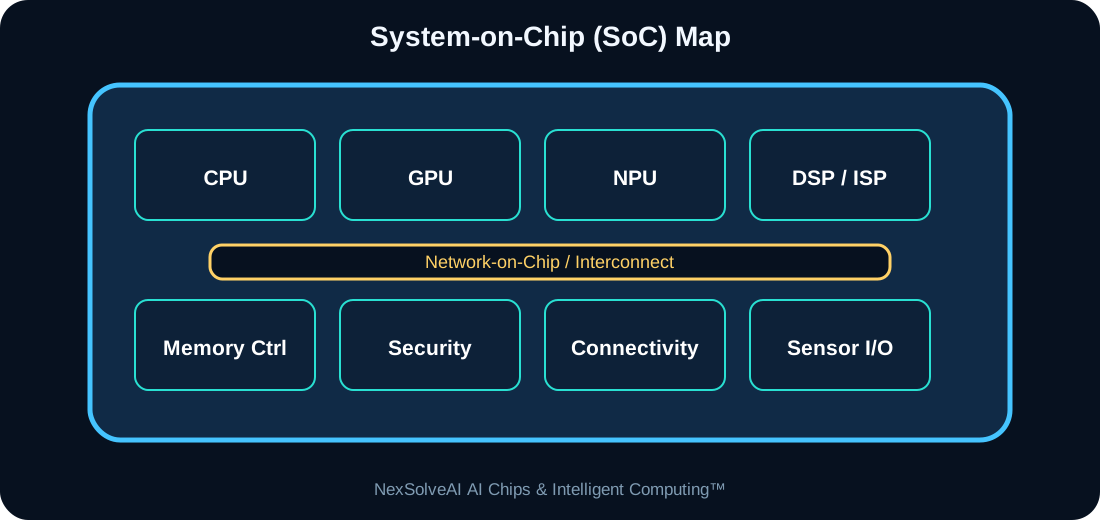
This figure is specific to AC-08 and illustrates the core architecture or dataflow discussed in this lesson.
Interactive Experiment
Integration score—
Estimated die area—
Power complexity—
Interconnect load—
Add blocks and observe integration costs.
Real-World Case Study
A robotics SoC may integrate CPU cores, GPU, NPU, ISP, video codecs, safety engines, memory controllers, Ethernet, CAN, and sensor interfaces.
Case-study task: Identify the most important compute, memory, power, and data-flow requirements in this example.
Engineering Challenge
Design a SoC for a battery-powered smart camera. Choose which blocks to include and which to omit.
Common Misconceptions
- Headline specifications should not be interpreted without workload context.
- Compute, memory, data movement, software, and power interact as one system.
- More hardware resources can show diminishing returns when another subsystem is limiting performance.
Interactive MCQ Quiz
1. What is an SoC?
2. What moves data between SoC blocks?
3. Why not include every possible hardware block?
Select your answers and submit the quiz.
Nexa AI Chip Tutor™
The future connected tutor can explain What Is a System-on-Chip?, interpret this module's experiment, and answer learner questions based on the current settings.
Suggested prompt: “Explain the experiment in AC-08 and tell me why the bottleneck changes when I move the sliders.”
Downloads
References & Further Study
- Computer architecture and digital systems textbooks
- Semiconductor and processor manufacturer educational documentation
- AI hardware, edge-computing, and embedded-systems documentation