Learning Objectives
- Define edge AI and distinguish it from cloud AI.
- Explain latency, bandwidth, privacy, and availability trade-offs.
- Estimate when local processing is advantageous.
- Recognize limitations imposed by edge power and memory budgets.
- Design a simple edge-vs-cloud decision.
Theory & Fundamentals
Local inference. Edge AI executes models on devices such as cameras, robots, phones, vehicles, gateways, or medical instruments.
Latency. Cloud processing adds network delay. Local inference can respond immediately when real-time action is required.
Bandwidth and privacy. Processing raw data locally can reduce network traffic and limit transmission of sensitive information.
Constraints. Edge devices have tighter power, cooling, cost, and memory limits than data centers, so models often require optimization and quantization.
Unique Visualization
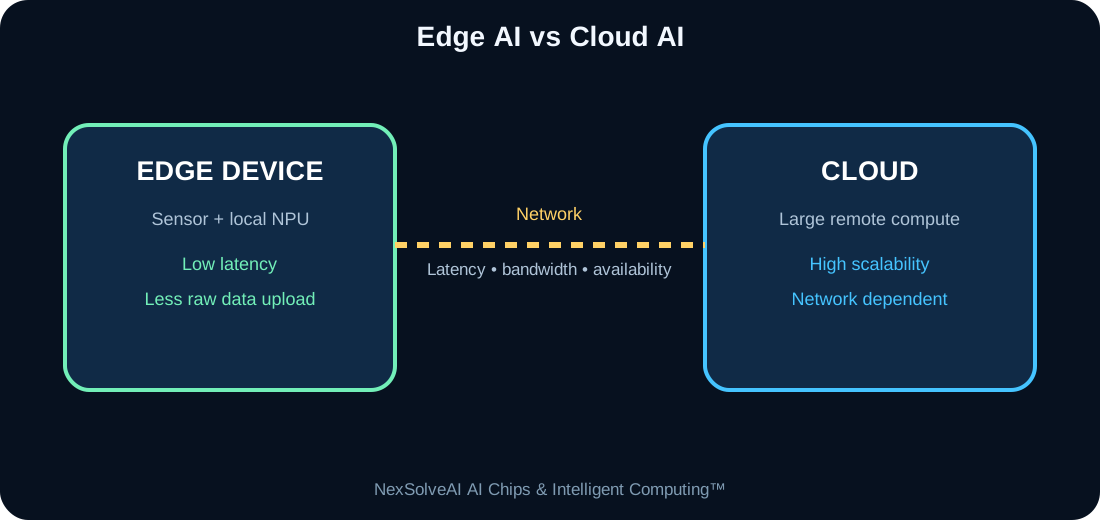
This figure is specific to AC-10 and illustrates the core architecture or dataflow discussed in this lesson.
Interactive Experiment
Edge response—
Cloud response—
Bandwidth saved—
Best fit—
Compare response time and network dependence.
Real-World Case Study
A safety camera in a factory may need to detect a dangerous event within tens of milliseconds. Waiting for a round trip to a remote cloud service may be unacceptable.
Case-study task: Identify the most important compute, memory, power, and data-flow requirements in this example.
Engineering Challenge
Compare edge and cloud execution for a medical wearable. List one advantage and one limitation of each.
Common Misconceptions
- Headline specifications should not be interpreted without workload context.
- Compute, memory, data movement, software, and power interact as one system.
- More hardware resources can show diminishing returns when another subsystem is limiting performance.
Interactive MCQ Quiz
1. What is edge AI?
2. Why can edge AI reduce latency?
3. What is a common edge constraint?
Select your answers and submit the quiz.
Nexa AI Chip Tutor™
The future connected tutor can explain What Is Edge AI?, interpret this module's experiment, and answer learner questions based on the current settings.
Suggested prompt: “Explain the experiment in AC-10 and tell me why the bottleneck changes when I move the sliders.”
Downloads
References & Further Study
- Computer architecture and digital systems textbooks
- Semiconductor and processor manufacturer educational documentation
- AI hardware, edge-computing, and embedded-systems documentation