Learning Objectives
- Compare flexibility, parallelism, specialization, latency, and efficiency.
- Match processor types to workload characteristics.
- Understand heterogeneous computing.
- Explore relative performance across general, graphics, and AI workloads.
- Avoid assuming the highest TOPS device is automatically best for every task.
Theory & Fundamentals
CPU. Best suited to flexible control, branching, operating systems, and diverse software.
GPU. Optimized for broad parallel throughput and useful for graphics, scientific computing, and many AI tasks.
NPU. Highly specialized for neural-network inference and efficient tensor execution.
Heterogeneous systems. Modern SoCs combine all three so that software can place each task on the most appropriate compute engine.
Unique Visualization
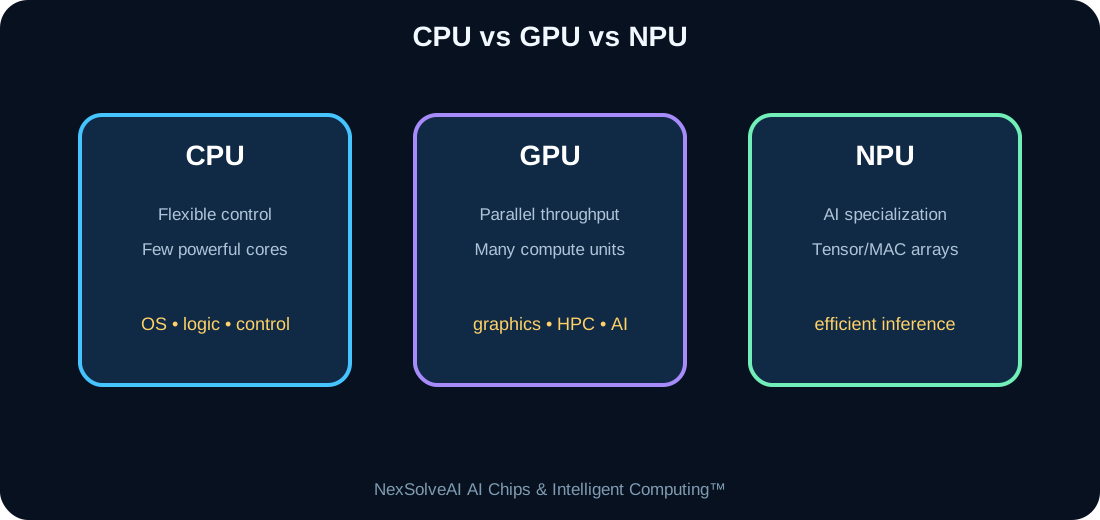
This figure is specific to AC-06 and illustrates the core architecture or dataflow discussed in this lesson.
Interactive Experiment
CPU
—
GPU
—
NPU
—
Select a workload and compare relative suitability.
Real-World Case Study
A smartphone photo pipeline may use CPU for app logic, ISP for image preprocessing, GPU for graphics, and NPU for scene recognition or enhancement.
Case-study task: Identify the most important compute, memory, power, and data-flow requirements in this example.
Engineering Challenge
Choose the best processor for five workloads: spreadsheet logic, 3D rendering, local object detection, operating-system scheduling, and matrix-heavy simulation. Justify each choice.
Common Misconceptions
- Headline specifications should not be interpreted without workload context.
- Compute, memory, data movement, software, and power interact as one system.
- More hardware resources can show diminishing returns when another subsystem is limiting performance.
Interactive MCQ Quiz
1. Which processor is generally most flexible?
2. Which is specialized for neural-network inference?
3. Why combine CPU, GPU, and NPU?
Select your answers and submit the quiz.
Nexa AI Chip Tutor™
The future connected tutor can explain CPU vs GPU vs NPU, interpret this module's experiment, and answer learner questions based on the current settings.
Suggested prompt: “Explain the experiment in AC-06 and tell me why the bottleneck changes when I move the sliders.”
Downloads
References & Further Study
- Computer architecture and digital systems textbooks
- Semiconductor and processor manufacturer educational documentation
- AI hardware, edge-computing, and embedded-systems documentation