Learning Objectives
- Define chip, integrated circuit, transistor, logic gate, die, package, and interconnect.
- Explain how transistor switching can represent binary information.
- Distinguish the silicon die from the package and printed circuit board.
- Estimate how integration level changes functionality, cost, and power density.
- Connect chip technology with phones, vehicles, medical devices, robots, and AI systems.
Theory & Fundamentals
From transistor to chip. A transistor acts as a controllable electronic switch. By combining transistors into logic gates, gates into functional blocks, and blocks into integrated circuits, engineers create processors, memories, interfaces, and accelerators.
Die and package. The die is the actual semiconductor piece. The package protects it, provides electrical contacts, supports heat removal, and connects it to the larger electronic system.
Integration. Modern chips place enormous numbers of devices and interconnects in a small area. Greater integration can improve capability and reduce communication distance, but it also increases design complexity and heat density.
Why chips matter for AI. AI workloads require huge numbers of arithmetic operations and rapid data movement. Modern AI chips therefore combine general processors, parallel engines, specialized accelerators, and high-bandwidth memory interfaces.
Unique Visualization
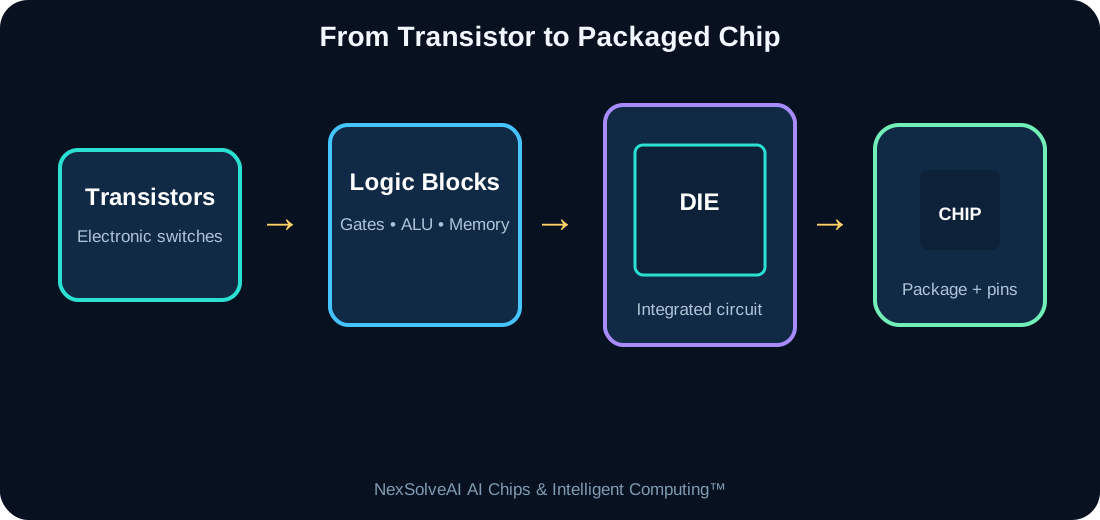
This figure is specific to AC-01 and illustrates the core architecture or dataflow discussed in this lesson.
Interactive Experiment
Functional density—
Interconnect distance—
Design complexity—
Heat density—
Increase integration and observe the system-level trade-off.
Real-World Case Study
A smartphone SoC combines CPU, GPU, NPU, image processing, memory controllers, security, and communication interfaces. The same physical chip therefore supports ordinary apps, photography, speech recognition, and local AI.
Case-study task: Identify the most important compute, memory, power, and data-flow requirements in this example.
Engineering Challenge
Imagine you must design a wearable AI device. List which functions should be integrated on-chip and which can remain external. Explain your choices in terms of size, power, heat, and data movement.
Common Misconceptions
- Headline specifications should not be interpreted without workload context.
- Compute, memory, data movement, software, and power interact as one system.
- More hardware resources can show diminishing returns when another subsystem is limiting performance.
Interactive MCQ Quiz
1. Which is the actual semiconductor piece inside a packaged chip?
2. What is the fundamental role of a transistor in digital logic?
3. Why can higher integration increase thermal difficulty?
Select your answers and submit the quiz.
Nexa AI Chip Tutor™
The future connected tutor can explain What Is a Computer Chip?, interpret this module's experiment, and answer learner questions based on the current settings.
Suggested prompt: “Explain the experiment in AC-01 and tell me why the bottleneck changes when I move the sliders.”
Downloads
References & Further Study
- Computer architecture and digital systems textbooks
- Semiconductor and processor manufacturer educational documentation
- AI hardware, edge-computing, and embedded-systems documentation